Gone Before You Knew Me: An Interview
By Hannah Johnson
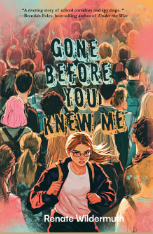
BGSU alumni Renate Wildermuth, who obtained her masters in German from BGSU, sat down to talk about her young adult novel Gone Before You Knew Me, releasing on February 24, and talk about the complicated experience of the American school system.
Can you tell me just a little bit about your book in your own words?
Wildermuth’s Gone Before You Knew me centers around a girl trying to make it out of high school alive. She mentions it’s obviously fiction, but it speaks to very real fears in this age, with procedures like Run, Hide, Fight or active shooter preparation protocol. This comes out of both teacher and student fears, and she says it was just a way to process all of that based on her own teaching experience and high school experience, too.
Where did the inspiration from this novel come from?
Wildermuth recalls when she started teaching full-time at a school in Pennsylvania, and they had their own teacher training on active shooter scenarios, including hands-on training for situations like preventing someone from bleeding out. She remembers they had a mannequin man there and they would take turns stuffing his chest cavity full of old rags, and how she was feeling a little ridiculous, scared, helpless, a little angry that they’re all in this situation in the first place. She thinks it came from all those feelings, and she just put them into her main character, Talya, and let her deal with it as well as give her the tools to do something about it.
The next question was about Wildermuth’s protagonist (Talya). She is described as being equal parts Katniss Everdeen and Harriet the Spy. Can you tell me a bit about your process of creating your characters and where the inspiration comes from?
Wildermuth says it comes from those feelings of being awkward but also you can try and be heroic. She thinks it’s a more realistic version of maybe what we’re all kind of like, in the sense that we can fake stepping up in a crisis but at the same time she mentions she never outgrew her own awkwardness, so it creates a little more realistic character.
How have the politics surrounding this issue (gun violence, school shootings) impacted or shaped how you wrote this novel?
Wildermuth goes back to mention her teaching experience, saying that as a teacher you feel like you’re always on the end of that whole topic. There’s gun violence. There’s threats to schools and teachers like Wildermuth are always in the position of the ones who have to be prepared for it and trained for it. She mentions her fear, and how this novel turns it on its head. Her protagonist does use a gun, though her weapon of choice is always her pencil, when she has to she resorts to the violence that we’re always used to being used against us. She addresses how issues surrounding guns is such a polarizing issue and a bumper sticker she saw once saying “Gun control means having two hands on the stock” and how angry that made Wildermuth, saying instead that if she had a bumper sticker it would say “My opinions are too nuanced to fit on a bumper sticker.” She says what she thinks is that we need is conversation, that it can’t simply be between no gun is bad and no gun is good. She mentions she would love to see conversation and more research into issues. When asked, she also mentioned that this was the first time she’s been asked this question but it’s something that’s been on her mind, cause she doesn’t want to be seen as encouraging school violence but school violence is a fact of life and this was her way to engage with it and imagine a scenario where you’re not just the victim.
How do you find your balance for different genres or stylistic elements that you include, like humor and romance and suspense? What is your method to blend these things together to make a cohesive narrative?
Wildermuth says that she thinks of genres as almost an artificial separation, mentioning that when we are all these early human beings sitting around the fire we would never hear someone say, “Tell us that post-apocalyptic story with high elements of fiction and you know make it YA.” She mentions an interview she got to do once with a man named Al Hyslop, a producer for Sesame Street, as well as an actor. She asked him how he sees himself, is he first an actor? He responded, not answering the question, by saying, “I am in the business of good stories well told” and how that quote has always stuck with Wildermuth, because she believes the story comes first, then everything else comes after. She thinks it’s important to pick a genre for marketing and publicity but generally, it’s the story. She says she has the opposite problem of writer’s block not to say she doesn’t get stuck on certain stories but she credits it to an “overactive imagination.” She can walk down the street and see two people interact and it’ll spark an idea or a story and then that kind of plays out in her head. She also recently came across maladaptive daydreaming where one will have these daydreams where you’re developing plotlines, with recurring characters, stretching over years and you prefer to spend more time with these imaginary characters than with real people and she saw that and thought how is that any different from the definition of a writer? She says the only difference is the writer is delusional and thinks people want to buy their daydream. She also grew up in Pennsylvania with an hour long bus ride, which she says taught her a lot about humanity, and in the book the main character describes school buses as a mosh pit on wheels with the only adult literally looking the other way and that did come from experience. So, at a very early age, she was telling herself stories and getting lost in that world as opposed to the chaos that was the bus.
What was your biggest challenge writing this novel?
Wildermuth said her biggest challenge writing the novel was thinking it was finished when it wasn’t. She mentions moving to Germany for a year and she had this gift of time after teaching full-time so she banged it out in three months and then spent two years pitching it and got a really blunt but amazingly helpful rejection that said she could probably take out a hundred pages and it’d be a better book. She says it was painful, how she thought she understood plot because she’s been writing trying to get published for around twenty years but she went to the library, took out all these books on plot, watched webinars and tore the book down, tore out the hundred pages, built ninety back in. She says the revision process was a lot more painful than the writing process, the writing process going relatively smoothly. After she revised it, the first time she sent it out she got a book contract so she says she’s gonna do that reverse order next time.
You have quite an extensive background on education, including at the high school level. How did that experience as an educator shape how you wrote this novel?
Wildermuth quotes Bowling Green as sparking her interest for teaching. She says she didn’t originally start out or go to school right away to be a teacher but it was at Bowling Green she thought to herself that she could do it and she enjoyed it. While she was enrolled in her masters in German she was given a whole class to teach and that really cemented the idea that she could teach. She also mentions an event on campus where high school students were brought in, how she enjoyed interacting with them, and how that’s what sparked her interest in working with the high-school level. She does mention that though this is a YA, really deep down, she wrote it as a teacher for teachers because it is a rewarding profession but there’s more and more red tape to it, more and more pressure about test scores, not even to mention threat of school violence and there are some humbling aspects to it, maybe part of this born out of the first time a student fell asleep in her class. She says you want to think of yourself as the kind of teacher that’ll never happen to and in the book she processes that through the main character falling asleep at one point at her desk but it’s because she’s learning hand to hand combat the night before. Maybe they didn’t fall asleep in her class that one time because she was boring, and instead it had a lot more to do with what they were doing outside of class.
What was your favorite part of writing this novel?
Wildermuth builds on some of her previous ideas of processing, saying her favorite part of writing the novel was being able to process certain things and maybe to be able to say things that maybe she wouldn’t say out loud. As an example, she uses motivational posters in this book, nonsensical ones like “dream big work bigger,” cause there are so many in schools it’s almost like it’s wallpaper and she thought if we need that much motivation to make it through the day then either we need to find a different career or we need some of those outside stressors to be taken away. She emphasizes that she’s a firm believer in public education and she thinks it’s at its core, it’s a fantastic concept that can make us all equal and raise us all up but it’s not without its issues.
Gone before You Knew Me is written in these redacted confessions. How does this format or layout impact your writing process and how did you approach this style?
Wildermuth begins with reiterating how this is so central to the plot and meant to read like a redacted confession so it’s in place for authenticity, but she also purposefully left out the name of the school and town because she wanted it to be that much closer to the reader. It could be every person’s school and she mentions when you look at the construction of schools, they’re pretty much all the same, the concrete block, sometimes no windows and there is a bit of a comparison here between the detention center, where she’s in solitary confinement, and what a school actually looks like because when she (Talya) describes her school in flashbacks she’ll say imagine my English classroom just like this detention cell except with motivational posters. Like Wildermuth mentioned earlier, she says public school is so important but students can feel like they’re locked in, and quite literally, you’re on lockdown. She mentions her time in Germany again, writing this in Germany and how different their system is. You can come and go. Children can get sent by themselves to school, a mile away across four lanes of traffic, something you’d be arrested for here. So, it’s crucial, she mentions along with her study abroad experience and language having the master’s from Bowling Green in German, being in a different place is so crucial to how we see our world ourselves and our culture and you can see what’s possible.
Renate Wildermuth also has a website and newsletter, as well as an author page with the publisher for more details. Wildermuth’s book has also made it into the top 100 best sellers on Amazon in their loner/outcast category.
Renate Wildermuth – Reading, writing, algorithmics