By Hannah Johnson
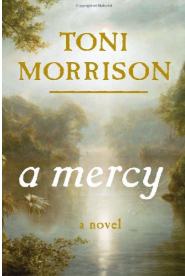
A Mercy – Toni Morrison
“I dream a dream that dreams back at me.”
Through A Mercy Toni Morrison addresses complicated themes of identity as well as how identities relate to one another in early American society. These unique markers of identity (race, class, etc) create unique relationships and experiences with identity in society. It’s asking what it’s like to be a woman in this society. What it is like to be enslaved or to be free. What does it mean when you’re both enslaved and a woman? This all functions in an intricate web Morrison creates and examines. This book puts together a handful of characters with various different unique identities and backgrounds and examines how they function in close proximity with one another, in such an early version of America. The novel examines how love functions in a society like this, amid this fragmentation of the soul and of society. The mother-daughter relationship is an asking of forgiveness, a plea to hear, a broken message amidst all the other brokenness.
Morrison wrestles with the voices that define American history, who has and who hasn’t gotten the right to speak. The reader can ask themselves how Floren’s voice has been represented in the deep, painful history of America and what that means for the narrative of American history. Has American history ever been given to us from a balanced perspective from those who actually lived it? Morrison answers these questions through her depiction of this social hierarchy, through the knowledge that certain voices, like Florens’ don’t hold up legally to others. With that awareness, the diversity of American voices disappears. Ideas like these have a ripple effect. What does this look like in real-life and modern America? Morrison answers this question of history through this outlet in which American history can be traced back, down to characters like Florens, who knew their voices didn’t hold up in this system, and give them that opportunity for their story. These ideas can be traced back from Morrison’s Pre-Revolutionary War America into today. This novel depicts an ongoing fight, ongoing pain, an ongoing resilience, an ongoing fight for love, in 1680 and resonating today.
Morrison also answers these questions of the American social hierarchy and societal roles through the relationships of the characters. She presents a subtle study of class between D’Ortega, and Jacob early in this novel, highlighting some of the conflict that arises from class, morals, and money. D’Ortega is a man with many debts and questionable morals to Jacob, who prefers keeping his hands cleaner. Morrison mentions differences in clothing, in silk versus rough collars. Even amidst disgust with a difference in morals, there is envy and there is money in these societal systems. Morrison also examines these relationships through the women, with how the women in this novel interact with one another and perceive one another. The identity of womanhood keeps these characters connected, amidst differences. They have each other, as women, and that amounts to something.
“There is no protection. To be female in this place is to be an open wound that cannot heal. Even if scars form, the festering is ever below.”
A Mercy is a societal and cultural study for anyone who is interested in early America, in diving deeper into what American society was like before the history begins with The Revolutionary War and America’s independence. It’s a brutal novel, unafraid of showing the unending violence and oppression of this era, for anyone who wants to explore the history of America from the voices and stories that have been erased.
“To be given dominion over another is a hard thing; to wrest dominion over another is a wrong thing; to give dominion of yourself to another is a wicked thing.”